Expert Leak Detection in Murray Hill Residential Buildings
Water intrusion in a dense Manhattan neighborhood is rarely straightforward. Whether you own a classic brownstone on East 36th Street, live in a high-rise cooperative apartment overlooking Second Avenue, or manage a rental property near the historic Morgan Library, concealed plumbing leaks can quickly turn into costly structural damage. Delivering effective leak detection Murray Hill Manhattan requires practical knowledge of vertical riser networks, shared plumbing chases, and historic construction materials found throughout East Side multi-family residences.
Water follows gravitational paths, traveling along steel structural beams, subfloors, and conduit runs. A damp stain appearing in your hallway ceiling may originate from a supply riser thirty feet away or two floors above. Rather than tearing down decorative plaster, marble tiles, or custom millwork, our team uses calibrated non-invasive electronic diagnostics to isolate moisture plumes before opening any building envelope.
Common Signs of Hidden Water Intrusion
Plumbing leaks frequently develop slowly inside enclosed wall cavities before breaking through to visible surfaces. Recognizing early symptoms helps property owners take timely action:
Ceiling Stains & Blistering Paint
Yellowish rings, water bubbles under latex paint, or crumbling plaster indicate a moisture source overhead. If you need ceiling leak repair Murray Hill Manhattan, identifying whether the moisture is active or residual is the essential first step.
Musty Odors & Persistent Humidity
Damp wall cavities cultivate fungal mold growth within 48 hours. A localized earthy odor near baseboards or under kitchen sink cabinets often points to a hidden drain stack fracture or fitting drip.
Warping Hardwood & Buckling Tiles
Subfloor moisture from a pinhole copper line or radiant pipe causes solid oak floorboards to crown or bathroom tiles to loosen, signaling active water travel underneath living spaces.
Continuous Water Flow & High Bills
If your building's master meter or submeter continues recording water consumption when all residential valves, toilets, and fixtures are idle, a concealed pressurized supply leak is actively discharging.
Suspect a Concealed Leak in Your Apartment?
Speak directly with a local plumbing diagnostic specialist to review symptoms and discuss immediate non-invasive inspection steps.
Multi-Unit Buildings & Apartment-to-Apartment Leaks
In typical Murray Hill apartment layouts, multiple residential units share common vertical plumbing risers for domestic hot water, cold water, and sanitary drainage. Addressing an apartment leak detection Murray Hill Manhattan scenario requires diplomatic coordination between unit shareholders, upstairs neighbors, and building supers:
- Water Leaking From an Upstairs Unit: If you observe a water leak from upstairs apartment Murray Hill Manhattan ceiling, the source is commonly an unsealed shower pan, a degraded toilet wax gasket, an overflowing washing machine trap, or a weeping radiator control valve.
- Shared Pipe Chase Riser Failures: In pre-war cooperatives, risers embedded behind wire lath and plaster deteriorate over decades. Vibration and water hammer stress brass and galvanized threaded fittings until a seam separates.
- Building Management Coordination: Before any invasive access or valve isolation can occur, the building superintendent or managing agent must be informed, especially if main building riser shutoffs are required.
Non-Invasive Diagnostic Methods
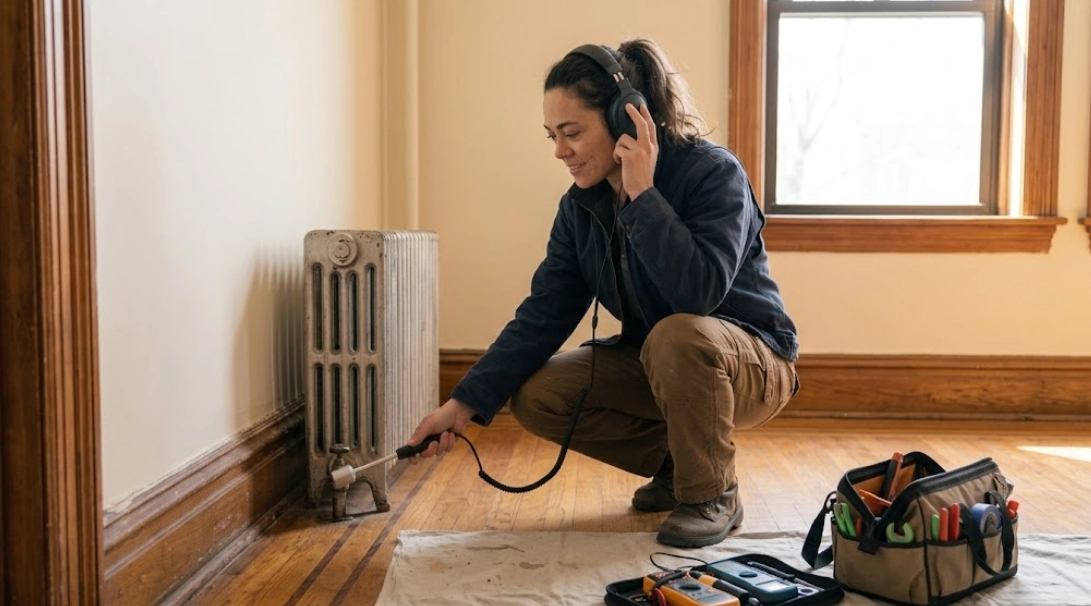
Locating concealed moisture requires scientific precision. When executing hidden water leak detection Murray Hill Manhattan, our technicians deploy multiple complementary testing technologies:
1. Precision Radio-Frequency Moisture Mapping
Pinless moisture meters emit safe electromagnetic signals into drywall, plaster, and tile up to an inch deep. By taking grid readings across suspect surfaces, we map relative moisture concentration to identify the wettest point behind the wall where the pipe fracture sits.
2. High-Resolution Thermal Imaging
Infrared thermal cameras detect subtle surface temperature differentials. Hot domestic water pipe leaks reveal radiant warm plumes blooming through plaster, while cold water supply leaks or drain leaks appear as cool evaporative thermal patterns.
3. Acoustic Ground Microphones & Correlators
When searching for a leak in wall detection Murray Hill Manhattan problem, pressurized water escaping from a pinhole defect emits distinct high-frequency acoustic vibrations. Ultra-sensitive listening discs amplify this sound through solid construction materials, allowing technicians to isolate the leak location to a narrow radius.
4. Systematic Isolation & Pressure Testing
By isolating individual plumbing branches with test gauges, we determine whether a pressure drop occurs on the domestic cold water, domestic hot water, or heating circulation loops.
Water leaking through ceilings frequently travels along metal electrical conduits and settles inside recessed ceiling light fixtures, junction boxes, or wall switches:
- Never touch light switches, wall outlets, or electrical appliances that are wet or in direct contact with leaking water.
- If safe to do so, turn off the individual circuit breaker feeding the wet ceiling or room at your electrical panel.
- Place buckets, plastic bins, or towels beneath active drips to protect flooring, and clear valuable furniture away from sagging plaster.
What Happens During a Professional Leak Assessment
A methodical on-site diagnostic visit follows a clear sequence designed to minimize stress and prevent unnecessary property damage:
- Visual & History Audit: We inspect the affected ceilings, walls, and flooring, gather details on when the leak appears, and review recent plumbing alterations in adjacent units.
- Moisture & Thermal Scan: We scan suspect building surfaces to establish boundaries of water intrusion and track moisture gradients back toward the plumbing chase.
- Fixture & Valve Testing: We check upstairs toilet tanks, shower diverters, washing machine hookups, and radiator valves to rule out localized fixture leaks.
- Surgical Access Recommendation: Once the leak source is isolated to a tight radius, we explain the findings to the property owner and superintendent. If physical repairs are required, our plumbers create a neat, minimal access opening rather than tearing open multiple walls.
- Permanent Pipe Restoration: We cut out damaged piping sections and complete permanent code-compliant repairs. Learn more on our dedicated pipe leak repair and whole-home repiping service pages.
Comprehensive Mechanical & Heating Services
In addition to specialized leak detection, NY Plumbing provides a complete suite of residential plumbing and heating services tailored to Manhattan properties:
- Pipe Leak Repair: Sectional replacements for corroded galvanized and pinholed copper piping.
- Repiping Services: Comprehensive riser and branch pipe replacements for older residential buildings.
- Water Heater Repair: Restoring domestic hot water for residential storage tanks and indirect boiler coils.
- Boiler Repair: Steam and hydronic heating system diagnostics for winter heating reliability.
- Gas Line Repair & Inspection: Certified gas piping pressure testing and Local Law 152 periodic surveys.
- Drain Cleaning: Mechanical augering and clearing for clogged kitchen sinks and branch lines.
- Backflow Testing: Annual testing and regulatory filings for NYC DEP compliance.
Local Service Coverage Across Manhattan's East Side
Our diagnostic technicians respond across the East Side of Manhattan, providing targeted leak detection near Kips Bay, responsive service for leak detection near Turtle Bay, and prompt investigations for leak detection near Gramercy. For full details on neighborhood housing stock and building coverage boundaries, visit our comprehensive service areas page or reach out directly through our contact page.
Frequently Asked Questions About Leak Detection
A continuous, steady drip indicates a leak in a pressurized domestic water supply pipe or central heating riser, both of which stay under constant water pressure 24/7. Even if the upstairs resident is away on vacation, pressurized water continues to escape through pinholes or cracked fittings until the isolating riser valve is shut.
Most standard homeowners and cooperative building insurance policies cover "tear-out and access" costs required to locate the source of hidden water damage, as well as the resulting damage to drywall, flooring, and personal property. We provide itemized diagnostic invoices and photographic reports to assist with claim documentation.
Uninsulated cold water pipes and central air conditioning chill lines passing through humid ceiling voids can sweat heavily during summer months, dripping water onto ceiling drywall that mimics a pipe leak. Our technicians test surrounding humidity, pipe surface temperatures, and conduct acoustic pressure checks to distinguish condensation sweating from active pipe wall breaches.
Under most Manhattan co-op proprietary leases and condominium bylaws, main vertical building risers and branch lines inside the common walls up to the fixture shutoff valve are building property, making their repair the responsibility of the cooperative corporation or HOA. Branch lines, exposed fixture connections, and alterations within the individual apartment are generally the unit owner's responsibility.
Speak Directly With a Local Leak Specialist
Don't let hidden moisture damage your Manhattan apartment. Call NY Plumbing for targeted leak investigation in Murray Hill.